

work :: essays | articles | projects | filmography | questions | media
 |
 |
north and south shaolin
Click here to view our filmography page for this film.
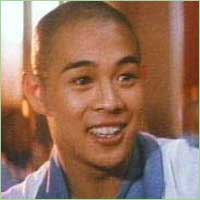 To tell the truth, I didn't really want to make a third Shaolin movie, but for various reasons, I had to. Unlike the first two films, none of us in the cast had much creative participation on Shaolin Temple 3, because the studio had hired Lau Ka-leung, a big Hong Kong director. In fact, this movie engaged a lot more people from Hong Kong for both the crew and the cast. On the previous two movies, everybody had been a mainlander. Now they were even bringing in stunt doubles from Hong Kong to help out with the shoot. Soon we started to notice certain discrepancies.
For Shaolin Temple, all of us had been paid 1 yuen/day. For Shaolin Kids, the cast and crew received 2 yuen/day. At the time, I hadn't thought too much about it; I didn't have a very clear concept of money. By the third movie, though, because I was a little older, I had a more mature perspective on things. I was starting to notice the existence of inequality in the world.
In a situation where all of us were earning the same amount of money -- if the lead actor and the lowest extra are both earning 1 yuen/day -- there wasn't much we could do about it, because we were working within a certain system. If we are living in a society which is organized along systematic lines to ensure that the distribution is completely equitable, I have no basis to dispute it. But if you bring in people from another system (in this case, Hong Kong) who are earning 150,000 yuen/month to your 3 yuen/day -- and they don't actually do anything -- then you start to notice social inequity. Backlash sets in; you develop a resentment against the work itself.
I wanted to ask the movie studio in Hong Kong why they were treating their two crews differently -- why they were creating divisions within a group that was supposed to work together. As lead actor, my job was quite a bit more demanding than that of a stunt double. I was fighting on camera from morning until night while they stood in back waving their swords and yelling -- and yet they were earning more than I did? I began wondering if I wanted to stay in this line of work.
I don't want it to sound like it was only me. There were many people on the set working very hard for next to nothing, simply because they were from China. The contradictions started to pile up in my heart as I realized that others perceived us and our work as less valuable. I started to think: "Just because I'm a mainlander, I'm supposed to expect this kind of treatment?"
Don't get me wrong: it wasn't all about money. We were separated by more than our salaries. The two crews even ate differently. We ate our simple mainland lunches, and the Hong Kong crew ate Cantonese food, which was provided to them via special catering.
In a commercial society, perhaps, this kind of stratification is very common -- even expected. In Hollywood, for example, the measure of an actor's stardom is the size of his trailer. But when discrimination is based on nationality, something is terribly wrong. It defied all logic. The studio was depending on me to sell their movie, but they weren't treating me with the most basic level of respect.
In a capitalist society, this would be unacceptable. In a socialist society, it was intolerable.
As a result of these conditions, my heart wasn't into the actual filmmaking. Instead of devoting myself to the act of making the movie, I was constantly resisting the circumstances under which the movie was being made.
This came to a head with a certain incident on the set involving a 4:00 a.m. shot. As you may know, scenes set at sunrise and sunset are the most difficult shots to film because the window of opportunity is so limited. A minute or two too late and the light is no longer what you need. In order to seize that brief moment, the crew must start preparing several hours ahead of time. We had such a shot in Shaolin Temple 3; all of us had to wake up at 2:00 a.m. to get to our location on time and set up the equipment. As daybreak approached, we all became very anxious...because the director was nowhere in sight. We waited.
The first light of morning came...
...and went.
We waited until 10:00 a.m. That's when the director finally showed up.
His first words were: "Aiya! The light's all wrong! Weren't we planning a sunrise shot? Oh well, guess we can't do anything about it now. Let's call it a day."
I felt like we were being toyed with. I believed that we had been the victims of a power play, or a mind game -- and that this little exercise had been completely unnecessary. Because of that incident, I went to great lengths to find the producer and to say these words to him:
"I may not know much about making movies. I've only made two, and I'm very young. So can I ask you a simple question? If the shot list calls for a scene to be shot at daybreak and the crew is ready at 3:00 a.m., and then the director shows up at 10:00 a.m. and says the light's all wrong, is he wrong or am I? See, I really don't understand much about filmmaking, and I'd like to learn. If you say I'm wrong, then I guess I really don't understand this industry, in which case I promise to go back home right now and never make another movie.
"On the other hand," I continued, "if you think the director's the one who needs to learn something about filmmaking, then maybe you'll agree that he owes the entire cast and crew an apology."
Well, here I am, still making movies.
So many problems cropped up during the making of that film. The set was brimming over with complex struggles; it really opened my eyes to issues of power and class. It was certainly the most tension-filled film I've ever worked on.
