

work :: essays | articles | projects | filmography | questions | media
 |
 |
born to defense
Click here to view our filmography page for this film.
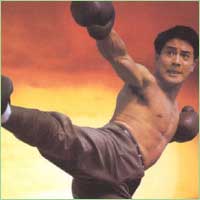 Thanks to the tension on the set of Shaolin Temple 3, I became very cynical about society. I was also totally soured on filmmaking. In fact, I had made the decision to get out of the movie business. When the film company heard about this, they insisted that I reconsider. "If you don't like these scripts, you can come up with some of your own," they said. "Would you like to direct your own film?"
Being young, I had two ways of thinking about this proposal: first, I saw it as an opportunity to express my own bitterness about society. Secondly, I could expose some of the social inequalities I'd encountered through the medium of film. In a nutshell, that's why I accepted the opportunity to direct a film of my own.
As a director in China, though, you couldn't depict actual incidents of discrimination too openly, because if you did, there was a chance the movie would be censored or shut down completely. So I disguised the story I wanted to tell with a different setting. The title of the movie is Chinese Hero; it was also known as Nameless Soldiers. In the West, it was released as Born to Defense. The story is very simple. As soon as I tell it, you'll know what I'm referring to.
The film is set in the city of Qingdao in Shandong Province. It takes place at the end of the Second World War. China, controlled at the time by the Nationalists, was one of the victorious nations; we had been aligned with the Allied Powers -- the United States, Britain, France, etc. The American and Chinese armies had defeated the Japanese and driven them from our soil. As the Chinese and American armies returned in triumph to Qingdao, the government busied itself to enthusiastically welcome the American soldiers as heroes. However, the Chinese soldiers, who considered themselves equal partners in the military victory, were blocked from entering the city. They were prohibited from using the main road, since it was being sealed off for the American troops' return. The Chinese troops reacted angrily: "Look, I risked my life out there on the battlefield for my country. If you're not going to welcome me home, then forget it. But let me get this straight: you're refusing to let me return to my own home because you're waiting for the other victors to arrive?!" The truth is, the two armies had helped each other win the war. Soldiers from both armies had risked life and limb, seen their comrades killed for the cause and perhaps been injured themselves. However, when the men who had been fighting to protect their motherland returned home, they found themselves unable to resume normal lives. They were scorned, or worse, ignored. To survive, they would have to suffer many more indignities.
The Americans were neither right nor wrong in this situation; it was the Nationalist government which treated them as great heroes and could care less about its own soldiers. So the American troops feasted, drank, whored and made merry, as many soldiers do wherever they are in the world. The Chinese soldiers, on the other hand, had to watch as their wives and daughters were taken to be prostitutes for the Americans, and nobody in power did anything to stop them. It was crooked, perverse.
Unfortunately, there are uncomfortable similarities between this story and the China of the late 70's and early 80's. For example, up until a decade ago, the Chinese government operated "Friendship Stores" that sold luxury goods; a foreigner with a passport could go inside to purchase what he wanted; Chinese, on the other hand, were not allowed to enter--even if they had the cash to afford those goods. My opinion about this was: For Heaven's sake, it's been 40 years--how come nothing has changed? If this is my country--why am I forbidden from entering a store to spend my own hard-earned money? Why is my government discriminating against its own people? Unless you lived through and experienced Chinese society at that point in time, you can't really understand how outrageous it was. There were even two kinds of currency: renminbi (RMB) for Chinese, and Foreign Exchange Certificates (FEC) for foreigners. Even if I, a Chinese citizen, came into possession of the foreigners' money, I couldn't use them to buy the things I wanted to, because I didn't have the proper documents. On the set of the movie, if I was thirsty, I had to use my RMB to buy a Chinese soda, whereas someone from Hong Kong could use his FEC to buy a Coca-Cola. Mind you, I wasn't angry because I couldn't drink a Coke; it was the principle of discimination that riled me. The fact is, I had no choice in the matter--because of my nationality. Because I was Chinese, I could not even entertain the possibility of eating or drinking those things.
When I accepted that opportunity to direct my own movie, my intention was to use a piece of history to talk about the present--basically, to say that China had not changed enough, even after 50 years of revolution. The star of Shaolin Temple 3 ate from Styrofoam lunch boxes, while a bit player from Hong Kong ate specially catered food, which we were not allowed to touch. Something was wrong. The society was warped.
This was 1986. I was about 23 years old then.
I'm older now, and maybe I understand more about how governments and societies work. I don't feel this intensely about these issues anymore, but at the time, I was quite young and quite angry. I guess you could say that the one time in my life that I tried my hand at directing, it was mainly to express my frustrations with the world. Perhaps I didn't tell the story very well, but I felt so strongly the need to express my sentiments about social conditions--about how outrageous it was that favoritism for foreigners still existed even after so many years.
So, because I was very young, my main purpose in making the film was to denounce the injustice, and to create an awareness in the audience that this was a society which sorely needed to be reformed.
Whether the audience could achieve this frame of mind by watching my movie was another question altogether--one which depended on my skill as a storyteller. I'd like to remind people that my storytelling was hampered by the reality of the censors. I couldn't be too overt about my message; effectively, I was trying to make my point with indirect analogies and connotations.
But in the final analysis, I don't think that I was a very successful director, because I did not achieve my purpose, namely, to get a lot of people to recognize my ideas or understand my point of view. Nor did I attract a lot of attention for trying to tell this story. No, I don't think of myself as a good director. I made the decision not to direct any more movies. Instead, I decided to direct my energies back into acting.
