

life :: articles | biography | essays | media | questions
 |
 |
life essay: part 12
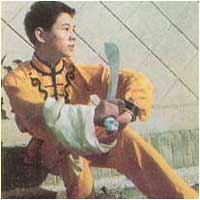 Because of my special relationship with the American presidency--that is, because I'd spoken so precociously to Nixon--I had secured my place in history. The Chinese government made sure of it; they declared that I had made a special contribution to Sino-American relations and put me on the invitation list for relevant state banquets. I was also appointed to the official welcoming committee for subsequent American presidents. When Ford and Carter made state visits to China, I was a member of the receiving line that met them at the airport.
Slowly, the chill of the Cold War was starting to thaw.
China and the U.S. had seen each other as enemies for so long because neither understood the other's culture or values. For example, those of us on the Beijing Wushu Team had been extremely anxious as we embarked on that first tour of the United States in 1974. We had no idea what to expect. And the bodyguards from the State Department were equally tense when they were first assigned to us. Both sides had been coached a little too well.
But after living together for a month, we came to realize that these decadent capitalists were actually kind and decent men, and they in turn realized that these communist kids weren't raving ideologues--in fact, we were rather cute. So everybody started to relax. Once people let down their guard, all sorts of interesting and unintended things slipped out, such as the fact that our bodyguards knew how to speak Chinese. Towards the end of the tour, I had become very comfortable with my bodyguard. One day, I tugged on his sleeve and told him with extreme urgency, "I HAVE TO GO TO THE BATHROOM!"
Without thinking, he responded in Mandarin: "Don't worry, I'll find a bathroom for you!"
I laughed. "Hah, so you really do speak Chinese!" He was very embarrassed.
The American bodyguards accompanied us all the way to Hong Kong, our last stop before returning to mainland China. In fact, that was the first time our bodyguards had had the chance to sit down and watch us perform--at every other performance, they had been preoccupied with security. When this last performance ended and it was finally time to say goodbye, people started crying. All forty of us were in tears. Male and female, young and old--no exceptions.
I still remember how one of the bodyguards stood up and made a little speech in Chinese: "For an entire month, we've been protecting you and I was so busy that I never had the chance to see you perform. I had no idea what you guys could do. And all this time, I've had to pretend that I didn't understand you--that I couldn't speak your language. We were told not to fraternize with our charges. Maybe I'm putting my career at risk by talking to you now like this, but who cares? I want to communicate with you!"
We saw the tears in his eyes and everybody cried some more. We didn't even know why we were crying, but it was just a feeling we had after a month together. We had bonded, and everybody was very sad.
A couple of years later, Gerald Ford became president and made a visit to China. I was one of the Chinese goodwill and friendship delegates who met him at the airport and escorted him to the Great Hall of the People for the state dinner.
It was a huge affair--the Great Hall is a gargantuan room that can hold hundreds of banquet tables. As I ate, I found myself idly glancing around at the sea of faces. My gaze settled on one face.
It was the American bodyguard who had made that tearful speech back in Hong Kong.
I was stunned and overjoyed. It was like seeing a long-lost friend. Grinning broadly, I jumped to my feet and yelled "HI!"
As soon as I did, I noticed that the two or three tables in front of him were filled with other bodyguards from that U.S. trip. They couldn't restrain themselves either. Leaping to their feet, they started waving back at me--"Hey there!"
All of us had a single thought--to walk over, shake hands, and hug each other.
All of us had totally forgotten that we were at a formal state banquet.
As soon as they stood up, we heard--like a chain reaction--twenty, thirty, forty chairs being pushed back and just as many bodies jumping to their feet. Chinese plainclothes police, other American security personnel--people who weren't in on the reunion.
For this kind of top-level banquet, it was standard practice to scatter plainclothes police throughout the hall. The Americans didn't know exactly who had been stationed to monitor them. But everybody had been watching each other very carefully. Watching for sudden movements.
That's why, when I suddenly stood up and the bodyguards jumped up, everybody else assumed that something dangerous was about to occur--that our yells of joy were yells of alarm.
How very awkward.
Turning around, I saw all these adults poised around me, looking very tense and alert. Some had instinctively shot forward to shield the two heads of state.
Very embarrassed, I nodded at everybody. "Uh, sorry..."
I carefully sat down again. The American bodyguards did likewise, assuring their colleagues that nothing was wrong.
Everybody finally understood that it had been a harmless misunderstanding. Slowly and awkwardly, people began sitting down, one by one.
The moral of this story is that even in times of tension and mistrust, people from two different cultures can form strong friendships that surpass all understanding.
